
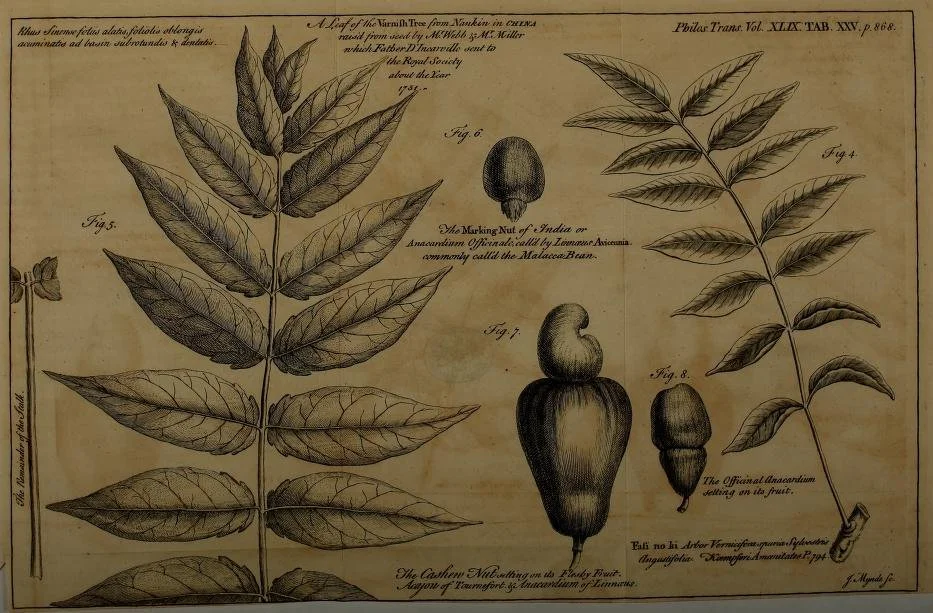
This presentation investigates a scientific controversy over the identity of the lacquer (‘varnish’) tree in the 1750s, a dispute that linked Asia, Europe, and North America through the circulation of texts, images, and specimens. Since lacquer was a prized commodity exported from China and Japan, European naturalists debated whether it could be cultivated in colonial America to reduce dependence on Asian imports.
At the heart of this controversy lay not only economic ambitions but also fundamental questions about credibility of testimonies, objectivity of images, and authority of early modern institutions in the making of botanical knowledge. The case turns especially on the written and visual instructions issued by figures such as John Ellis to his colleagues in Asia and America for identifying, collecting, and shipping specimens–working methods that both enabled and constrained transregional knowledge-making.
This presentation takes the writings and correspondence of John Ellis, Philip Miller, Carl Linnaeus and their informants in America and China as a central case study. By tracing this debate, the presentation addresses three wider questions. First, how were forms of evidence (visual, textual, and material) weighed and contested in eighteenth-century science? Second, how did knowledge from Asia—whether transmitted via Jesuit networks, VOC officials like Rumphius, or Kaempfer’s Japanese materials—intersect with European taxonomic systems? Third, how did these debates reflect the entangled relations among individual naturalists, the Royal Society, and the Philosophical Transactions in the making of knowledge, considering especially that this journal was just formally taken over by the Society in 1752?
Yunting Gu is a PhD candidate in the National Institute for Advanced Humanistic Studies and Department of History at Fudan University, Shanghai. Her research interests include history of early modern science, Dutch colonial history and Southeast Asian history, with a particular focus on recovering marginalised voices and reconstructing the multi-sited labour that shaped scientific and medical knowledge. She has been a visiting scholar at EHESS-CAK with funding from the French Embassy in China, and is currently a visiting PhD student at the Department of History and Philosophy of Science at the University of Cambridge. Her dissertation examines the Maluku Islands through the combined lenses of history of science and labour history, exploring how global knowledge was produced through local work, expertise, and cross-cultural encounters.
For the Zoom link, please email instructingnaturalhistory@uu.se
Image: John Ellis, Philosophical Transactions (1755-1756) vol 49, p. 868